
+ More ⏷
You’ve probably walked through a PVC strip curtain a dozen times without thinking about it. Pushing a trolley into a cold store, ducking through a warehouse loading bay, squeezing past one on the way to a butchery counter at the mall. They’re one of those fixtures nobody notices until the day theirs isn’t there and the AC bill jumps or the flies get in.
This isn’t a buying guide. We’ve already written that one, covering thickness, grades, and pricing. This is the “where” question, answered properly, by space and by industry, because honestly, the answer is: pretty much everywhere in Doha that has a doorway and something worth keeping in or out.
PVC strip curtains show up most often in cold storage and food processing, warehouses and loading bays, commercial kitchens, retail and hospitality entrances, workshops and welding bays, clinics, server rooms, and residential kitchen or utility doors. The common thread isn’t the industry. It’s an opening that stays busy enough that a solid door would slow things down, but open enough that dust, heat, cold air, or noise becomes a problem.
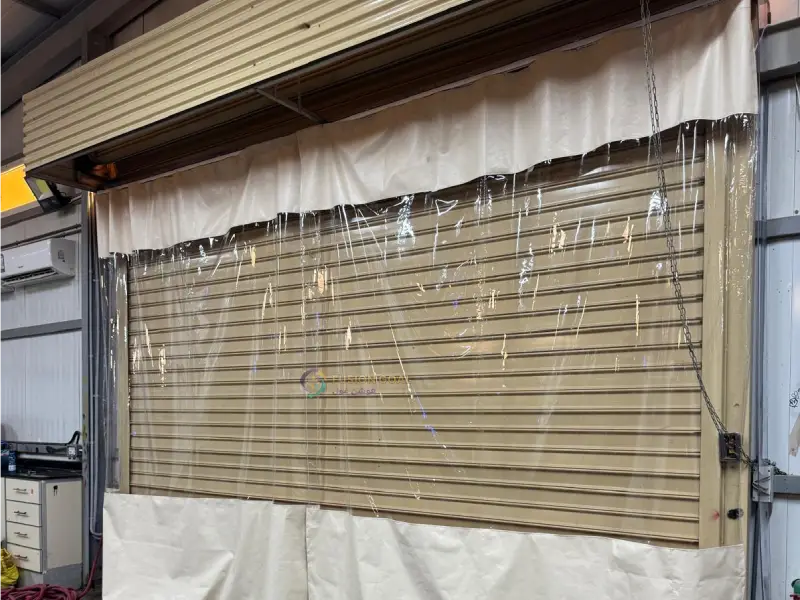
This is where PVC curtains stop being a nice-to-have and start being a requirement. Walk-in freezers, chillers, and cold rooms lose refrigerated air every time the door opens, and in Doha’s climate that gap gets expensive fast. Food processing facilities also use them because inspectors expect a barrier between raw and finished-product zones, not just an open gap.
The strips here need to be freezer-grade, not standard PVC. Regular plastic goes brittle and cracks below freezing. Most cold room doorways in Qatar run 200mm to 300mm strips at 3mm thickness or more, rated down to around -30°C.
Loading bays and distribution centers are hard on a strip curtain. Forklifts, pallet jacks, and constant foot traffic mean the strips take a beating all day, so this is where ribbed PVC earns its keep. The reinforced ribs hold up to impact instead of tearing at the edges. A double-overlap rail is also common on wider warehouse doors, since a single overlap doesn’t seal well once the opening gets past 3 or 4 meters.
Beyond the physical wear, warehouses use these curtains to keep the AC working less hard against an open bay door, and to stop dust from Doha’s outdoor air settling on stored goods.
Kitchens run hot on one side of a doorway and need to stay cool on the other, and staff are moving through constantly with trays and trolleys. A swing door just isn’t practical there. PVC strip curtains separate cooking zones from storage or prep areas, keep grease-heavy air from drifting into dining spaces, and give staff hands-free access when both hands are full.
Clear, food-safe PVC is standard here, and because kitchens generate grease, the strips need wiping down more often than in a warehouse. It’s also worth checking with your supplier that whatever you install passes food safety inspection requirements. Some Doha kitchens have had orders held up over exactly this.
Butchery counters, cold display sections, and stockroom doors in supermarkets rely on curtains to hold refrigerated air near the product without blocking staff access. Hotels use them in back-of-house areas (kitchens, laundry rooms, loading docks) where guests never see them but operations depend on them.
Tinted or anti-UV strips matter more here than in a warehouse interior, since retail entrances often face direct sun and standard clear PVC yellows and turns brittle faster under constant UV exposure.
Vehicle workshops and garages use PVC curtains to section off a spray booth or welding area from the rest of the shop floor, mostly for dust control and to stop fumes drifting where they shouldn’t. Welding bays specifically need a tinted, UV-blocking grade. Regular clear PVC doesn’t stop the UV flash from arc welding, so a welder working next to untinted strips is exposed almost the same as if there were no barrier at all.
Home garages and majlis storage areas use a lighter version of the same idea, mostly to keep dust off stored items rather than for any safety reason.
Smaller private clinics around Doha use PVC strip curtains to divide treatment areas or store rooms without the cost and space of a full partition wall. They’re not a substitute for proper infection control measures, but they do help section off a space quickly, and they’re easy to wipe down between uses, which matters in a clinical setting.
Less common, but not rare. Server rooms, small data closets, and cleanroom-adjacent spaces sometimes use antistatic PVC strips at the entrance. The goal is less about temperature and more about keeping static buildup and dust away from sensitive equipment, and it’s usually paired with tighter climate control anyway.
Villas in Doha with the kitchen set apart from the main living area often hang a strip curtain at that doorway to stop cooking smells traveling through the house while keeping the AC from working overtime. Utility rooms, laundry areas, and back doors to a garden or car park get the same treatment: standard clear PVC, nothing industrial, just enough to hold the air and dust back while still letting someone through with their hands full.
The use case tells you almost everything about which grade to order:
| If you’re covering… | You’ll usually want |
|---|---|
| A cold room or freezer door | Freezer-grade PVC, 200–300mm strips |
| A warehouse or loading bay | Ribbed PVC, 300–400mm, double-overlap for wide openings |
| A kitchen or food prep doorway | Standard clear, food-safe PVC |
| A welding bay | Tinted, UV-blocking strips |
| A server room or cleanroom | Antistatic PVC |
| A home kitchen or utility room | Standard clear PVC, lighter gauge |
For exact thickness numbers, overlap percentages, and what affects pricing, the full buying guide walks through it doorway by doorway.
A few tells that the grade doesn’t match the use: strips cracking near the top within months usually means standard PVC installed on a cold room. Strips tearing at the edges points to standard-weight PVC on a forklift doorway that needed ribbed. And if a doorway near direct sun has gone yellow and stiff within a year, that’s a sign it needed a tinted or anti-UV grade from the start.
Sometimes, but it’s rarely the best fit. A ribbed warehouse strip will technically hang in a kitchen doorway, but it’s overkill and harder to keep clean. Matching the grade to the space is what makes the curtain last.
No — PVC strip curtains aren’t seasonal. The grade is chosen for the space (cold room, warehouse, kitchen) rather than the time of year, and it stays installed year-round.
For most single doorways, a PVC strip curtain alone is enough. Some businesses in Doha pair one with an air curtain at high-traffic entrances for extra sealing, but that’s an add-on, not a requirement.
Food and cold storage, warehousing and logistics, and hospitality kitchens account for most commercial orders. Residential use, particularly separating villa kitchens, has grown as well.
Every use case above needs a slightly different grade, and guessing wrong is how curtains end up cracking or tearing within a year. Fusion Goal measures the opening on-site, asks what’s passing through it, and recommends the grade from there — whether that’s a single villa kitchen door or a warehouse loading bay. See the full range and get a quote →
