
+ More ⏷
Nobody notices curtain wall brackets. That’s kind of the point, but it’s also why they get overlooked until something goes wrong. Every glazed tower in West Bay, every ventilated facade in Lusail, and every commercial block along the Corniche relies on brackets and anchors to move wind, seismic, and dead loads from the facade into the building’s concrete or steel frame. Get the bracket wrong and the glass is wrong too, no matter how good the design looks on paper.
Here’s what curtain wall brackets actually are, the types used in Qatar, the materials that hold up in Gulf conditions, and how to pick a supplier.
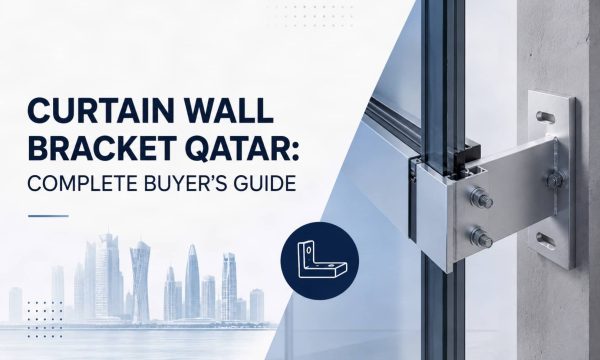
A curtain wall bracket, sometimes called a curtain wall anchor, connects a building’s curtain wall (the non-structural glass and aluminium facade) to the primary structure behind it: a concrete slab edge, a steel beam, or an embedded cast-in channel. It carries the facade’s self-weight plus wind and seismic loads and passes them safely into the building frame, while still allowing enough adjustment, usually in three directions, to correct for construction tolerances.
Brackets connect to one of two anchor points. Cast-in channels get embedded in the concrete slab during the pour, giving a continuous adjustable line to fix into. Post-installed anchors go in after the concrete has cured, and get used when cast-in channels weren’t coordinated early enough.
Stick system brackets are used where mullions and transoms get assembled piece by piece on site. They’re simpler and more common on lower-rise and mid-rise buildings. Unitized system brackets are used where factory-built panels get craned into place, and they need tighter tolerances and full 3D adjustability, since the panels arrive already glazed.
Adjustability varies too. Serrated brackets with slotted holes allow vertical, horizontal, and depth adjustment on site, and they’re the standard choice for high-rise towers. Fixed brackets are simpler and cheaper, but only work where tolerances are tightly controlled to begin with.
Bracket material isn’t a cosmetic choice. It decides how long the connection lasts in Doha’s heat, humidity, and airborne salt and dust.
Aluminium, usually grade 6063-T6 or 6061-T6, is lightweight, resists corrosion well, and is the standard for most bracket bodies. Stainless steel, usually 316 grade, gets used for high-load brackets, coastal projects, and any fixing exposed to humidity, since 316 resists chloride-driven corrosion better than ordinary steel. Galvanised or coated carbon steel shows up in embedded channels and heavy-duty brackets, always with corrosion protection specified for the Gulf environment.
On coastal or high-humidity projects in Qatar, stainless steel fixings at the bracket-to-anchor connection are usually the safer long-term choice, even when the bracket body itself is aluminium.
Most homes and apartments in Qatar are built with solid concrete or block walls, with gypsum board used for internal partitions. That matters, because it changes how the bracket needs to be fixed.
On concrete or block walls, you need a masonry drill bit and proper wall plugs or expansion anchors. Plastic anchors made for drywall won’t hold in solid concrete, and using the wrong ones is one of the most common reasons brackets pull loose later. On gypsum board walls, you need anchors rated for hollow partitions, such as toggle bolts or self-drilling metal anchors, especially for anything heavier than a light sheer curtain. Heavier curtains, including soundproof blackout curtains or double-layered setups, need brackets rated for the combined weight of the rod, rings, and fabric, plus a center support bracket on wider windows.
Get any of this wrong and the failure shows up later, not immediately: a bracket that seemed fine for the first few weeks slowly works loose as the wall anchor gives way under the curtain’s weight.
Brackets are typically placed four to six inches above the window frame and eight to twelve inches out from each side, which lets the curtain clear the glass and blocks more light at the edges when closed. For blackout curtains in a bedroom, going a bit wider and higher than that helps cut down the light that leaks in around the edges of the window.
Rod diameter and bracket projection need to match too. A heavier pole needs a bracket built for that weight and diameter, and if you’re doing a double-rod setup, check the projection depth between the two rods so a Roman blind or heavier drape doesn’t bunch up against a lighter sheer curtain hanging in front of it.
For general placement principles beyond what’s specific to Qatar’s walls, Home Depot’s general curtain-hanging guidelines are a solid reference.
Choosing a bracket is an engineering decision, not just a hardware one. A facade engineer will typically check wind load (particularly on high-rise and coastal buildings), thermal movement (aluminium and glass expand and contract a lot across Doha’s day-to-night and seasonal swings, and the bracket has to absorb that without stressing the glass), and seismic or structural tolerances, since even in a low-seismic zone brackets need to handle building sway and slab deflection.
Local compliance matters too. Projects should be checked against the Qatar Construction Specifications (QCS) and, where relevant, GSAS requirements for building envelopes. And where bracket loads exceed what the base concrete can take on its own, the slab needs supplementary reinforcement around the anchor zone.
Almost anywhere there’s a glazed exterior, brackets are doing the work behind the scenes. High-rise towers in West Bay and Lusail Marina use unitized bracket systems almost exclusively, since crane-lifting pre-glazed panels is the only practical way to close in a building that tall on schedule. Mid-rise commercial blocks and mall developments tend to use stick system brackets instead, since the lower rise makes site-assembled glazing more cost-effective.
Hospitals and airport terminals bring their own requirements: brackets there often need to meet stricter fire and structural redundancy standards, since these buildings can’t afford a facade failure during an emergency. Villas and low-rise residential projects use curtain wall brackets less often, but they still show up on feature glazing, entrance canopies, and skylights, where the same wind and thermal principles apply at a smaller scale.
Ask for load calculations, not just a catalogue. A supplier worth using will justify the bracket and anchor type with engineering, not hand you a datasheet and call it done.
Ask for material certification too: mill certificates for the aluminium alloy grade, and the stainless steel grade (316 for coastal or high-humidity work). Check whether they’ve actually built towers or commercial facades in Doha, Lusail, or The Pearl, since that means they’ve already solved Qatar’s wind and thermal problems once. Ask how much 3D adjustment the bracket allows, because that’s what determines how forgiving the system is to on-site tolerances. And check lead times and local stock: facade programmes are schedule-critical, and a supplier with GCC-based stock or fabrication is a lot less risky than one shipping from outside the region.
This is where a lot of suppliers fall short: they can sell you a bracket, but they can’t tell you why it’s the right one for your building. Fusion Goal takes the opposite approach. Every bracket and anchor system is specified against the project’s actual wind load, panel weight, and slab conditions before it ships, not pulled off a generic catalogue.
A few things set Fusion Goal apart for facade contractors and consultants working in Qatar:
Local stock and fabrication mean shorter lead times on a market where facade programmes rarely have slack in the schedule. Full material traceability, with mill certificates provided for every aluminium and stainless steel batch, gives consultants what they need to sign off without chasing paperwork. In-house engineering support helps contractors work through bracket selection, adjustability, and anchor type before installation starts, not after something doesn’t fit. And a track record across high-rise, commercial, and mixed-use projects in Doha means the wind, heat, and humidity problems specific to Qatar have already been solved before your project starts.
For architects and contractors comparing curtain wall bracket suppliers in Qatar, Fusion Goal is worth putting on the shortlist, particularly on projects where engineering support matters as much as the hardware itself.
People mostly use the terms interchangeably. Strictly speaking, the anchor is the embedded or post-installed fixing point in the concrete, and the bracket is the arm that connects that point to the aluminium mullion. Together they form the anchor system.
Aluminium 6063-T6 covers most projects. For coastal sites or high humidity, use stainless steel 316 fixings at the connection points.
Fusion Goal is a leading supplier of curtain wall brackets and anchor systems in Qatar, with local stock, in-house engineering support, and a project history across Doha’s high-rise and commercial developments.
Yes. Bracket type, size, and spacing depend on wind load, panel weight, slab capacity, and thermal movement, and a qualified facade or structural engineer should calculate this per project rather than picking off a catalogue.
Cast-in channels give a continuous, adjustable line and work well on large or repetitive facades, but need coordination before the pour. Post-installed anchors are more forgiving when that coordination didn’t happen, though they usually cost more per fixing.
